Legal services, insurance, and personal finance pay the most per click on Google Search. So do B2B software and cybersecurity. That’s based on Keyword Planner data and industry benchmarks through mid-2026. Real estate, online education, home services, and web hosting also carry bids well above the $5.42 average cost per click across all industries.
None of that tells you what you’ll earn from AdSense. An advertiser’s cost per click is an auction price paid to Google. AdSense pays publishers a share of ad revenue per impression, not the advertiser’s bid handed over whole. That share depends on far more than the keyword in your headline.
Every CPC and bid figure below has a named source and a pull date. Auction data this specific goes stale within months, not years.
High-Paying AdSense Niches at a Glance
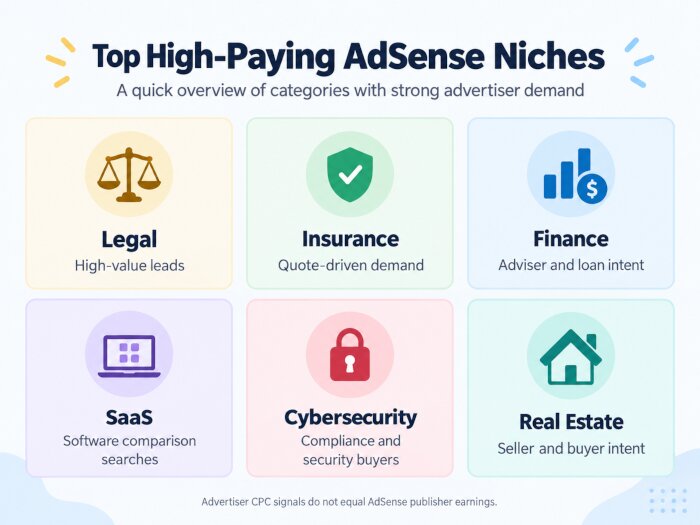
“Advertiser bid signal” below is the Keyword Planner top-of-page bid range. Google Ads describes this as an estimate of the 20th and 80th percentile of what advertisers have recently paid. That’s the price to reach the top of the results page. It is not a promise of future cost. It is not an AdSense payout.
| Niche | Example Keyword | Advertiser Bid Signal | Monthly Search Volume (US) | Search Intent | Publisher Notes |
|---|---|---|---|---|---|
| Legal Services | Truck collision attorney | $54 to $732 (Keyword Planner, Jul 2026) | 60,500 | Local service, lead generation | Needs real topical authority to have any shot at ranking |
| Insurance | Business insurance | Up to $79.39 (Keyword Planner, Apr 2026) | 10K to 100K | Comparing quotes | Auto and life insurance sub-niches are easier to enter |
| Personal Finance and Loans | Talk to a financial advisor | Up to $52.69 (Keyword Planner, Apr 2026) | 100 to 1K | Lead generation | YMYL topic, needs careful sourcing, no personal advice |
| Real Estate | Get offer on house | $73 to $215 (Keyword Planner, Jul 2026) | 20 | Transactional, lead generation | Cash buyer and sell-fast terms outbid luxury listings |
| Online Education | Online college business degree | $45 to $135 (Keyword Planner, Jul 2026) | 320 | Comparing programs | Comparison content fits well; avoid enrollment claims |
| B2B Software and SaaS | Help desk software for small business | $14 to $49 (Keyword Planner, Jul 2026) | 390 | Comparison shopping | Review and comparison formats are a natural fit |
| Cybersecurity | Soc 2 compliance companies | $38 to $419 (Keyword Planner, Jul 2026) | 140 | Vendor research | Compliance long-tails are less crowded than head terms |
| Digital Marketing | Linkedin advertising | $23 to $297 (Keyword Planner, Jul 2026) | 9,900 | Learning, hiring an agency | Fits existing marketing and SEO blogs directly |
| Home Services | Water damage restoration dallas | $22 to $113 (Keyword Planner, Jul 2026) | 1,300 | Local, urgent | Local map results dominate; hard for a national blog |
| Web Hosting | Blog hosting | Up to $43.70 (Keyword Planner, Apr 2026) | 1K to 10K | Comparison shopping | Heavy affiliate competition; needs a specific angle |
Some rows show a full bid range. Others show one high-range figure. That’s simply how each source reported the number. Treat every figure as a snapshot from its stated pull date, not a live price you can count on today.
How AdSense Actually Pays Publishers
AdSense does not hand you an advertiser’s exact CPC bid. Instead, publishers earn an effective cost per mille, or eCPM, based on ad impressions. Google turns every winning auction into that impression-based rate before it reaches your account. AdSense moved fully to this per-impression model for AdSense for Content, matching how most other display ad networks already work.
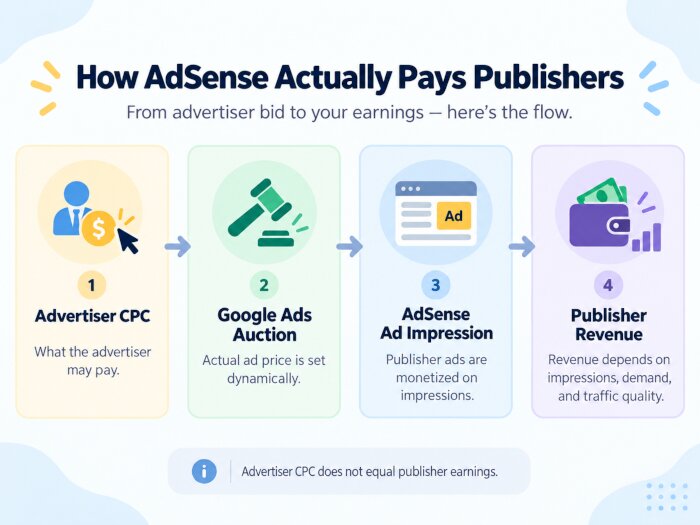
Google’s own AdSense Help pages state that publishers keep 80% of the revenue for AdSense for Content, after the advertiser’s platform takes its cut. When an advertiser buys through Google Ads itself, that works out to about 68% for the publisher. AdSense for Search, which lets a site run Google-powered search results with ads, pays publishers 51% of the revenue Google recognizes from clicks. These percentages hold no matter where a publisher is based.
So a $700 top-of-page bid on a legal keyword does not mean $700 lands in your account. It doesn’t even mean $476 (68% of $700). Advertisers rarely pay their full top-of-page bid. Google Ads runs an auction where the winning price is just enough to beat the next-highest bidder. AdSense also pays per impression across a whole page, not per click at the advertiser’s rate. Two sites can rank for the same high-CPC keyword and still post very different AdSense earnings. What changes the outcome includes:
- The visitor’s country and advertiser demand there.
- How competitive the ad auction happens to be at that moment.
- The quality of the traffic, not just its size.
- Whether ads are seen, not just loaded.
- Device type. Mobile and desktop ads price differently.
- The time of year. Q4 often draws stronger demand.
- What the visitor was looking for.
- Where ads sit on the page, and how many run there.
- The quality of the content around the ad.
- Whether the topic fits what advertisers consider brand safe.
None of this makes CPC data useless. A keyword with strong advertiser demand is still a fair signal that the topic has commercial value. It just isn’t a direct conversion from advertiser bid to publisher paycheck.
High-Paying Niches and Real Keyword Examples
The niches below show up across more than one independent source. Each includes a sourced keyword example, a read on intent, and a note on what fits a typical publisher site.
Legal Services
Personal injury, accident, and mass-tort law draw the highest advertiser bids of any category in this research. A single signed case can be worth tens of thousands of dollars in fees. That’s why firms can pay hundreds of dollars for one click.
“Truck collision attorney” carried a top-of-page bid range of $54 to $732 on Keyword Planner. That data was pulled in July 2026 for US targeting, on about 60,500 monthly searches. Ahrefs runs its own most expensive keywords study, last updated September 1, 2026. It found several mesothelioma and slip-and-fall attorney terms sitting at its data ceiling of $100 per click. Volumes on those terms were much lower, often under 1,000 searches a month. Across the wider legal category, WordStream by LocaliQ’s 2026 benchmarks put the average Search CPC for attorneys at $9.87. That’s the highest of any industry it tracks. Ahrefs also found legal services made up 17.52% of the 10,000 most expensive keywords it studied, by far the largest single category.
Search intent here is almost entirely local and lead-focused. That’s a hard reality for a general blog. Ranking for competitive legal terms often needs real topical authority. It also helps to have actual case results or a legal-industry connection. Legal explainer content works better. Think simple questions, like what documents a process needs. That has a better shot at organic traffic than head terms like “personal injury lawyer.”
Insurance
A single policyholder can bring in years of premium revenue. That’s part of why insurance advertisers bid hard even on already high-volume terms. Keyword Planner data from April 2026 puts the top-of-page bid high range for “business insurance” at $79.39. “Auto insurance” and “car insurance quotes” both sit around $65 to $68, on search volumes in the hundreds of thousands per month in the US. Auto insurance carries the heaviest volume of the insurance sub-niches. Life and health insurance terms tend to bid lower.
Most people searching these terms are comparing quotes, or trying to understand what a policy covers. Comparison content and “best insurance for X” guides fit publishers well. Insurance is still a YMYL topic, though, so accuracy and clear sourcing matter more here than in most niches.
Personal Finance and Loans
Advertisers in lending and wealth management can justify high bids because one funded loan, or one new client, carries real long-term value. “Talk to a financial advisor” showed a top-of-page bid high range of $52.69 in the same April 2026 Keyword Planner data. Related phrases like “find a financial advisor” sit in a similar range. On the lending side, business credit and invoice factoring terms have priced between $50 and $200 in past Keyword Planner data. These shift fast with interest rates, so check them again before use.
Lending and advisory content sits squarely in YMYL territory. Explainer and comparison content is a safer lane for publishers. Think pieces on how a loan type works, or what to compare between lenders. Avoid anything that reads like personal financial advice.
Real Estate
The highest-paying real estate keywords aren’t the ones you’d expect. “Luxury real estate” bids modestly. Phrases about selling a house fast for cash bid far higher, because they target motivated sellers and cash-buyer investors, not casual browsers.
“Get offer on house” carried a top-of-page bid range of $73 to $215 in the July 2026 Keyword Planner pull. Volume was thin, at about 20 searches a month. That shows how a small, highly qualified audience can still carry a strong bid. Broader phrases like “sell my house fast” carry more volume with somewhat lower bids, per Keyword Planner data reported by Publift in April 2026.
Most of this traffic wants a written offer or a fast sale, not casual browsing. General real estate blogs have a better shot with informational content about buying, selling, and financing than with the highest-bidding cash-buyer terms. Those tend to belong to investor and iBuyer companies running dedicated lead sites.
Online Education
A single enrolled student can be worth thousands of dollars in per-lead value to an online degree program, and the bidding shows it. “Online college business degree” carried a top-of-page bid range of $45 to $135 in the July 2026 Keyword Planner data, on about 320 monthly searches. Program comparison terms for MBA, criminal justice, and healthcare administration degrees showed a similar pattern in Keyword Planner data reported by Publift in April 2026.
These searchers are comparing programs, cost, and accreditation before they apply. Publishers who write really useful comparison content have a workable niche here. Google still holds education content that resembles advice on a real financial decision to the same YMYL bar as other sensitive topics. Avoid anything that reads like an enrollment guarantee or a promised salary outcome.
B2B Software and SaaS
Software categories with high per-customer value, like help desk platforms, ERP systems, and HR software, show some of the widest bid ranges in this research. One closed deal can be worth thousands in annual contract value. “Help desk software for small business” had a top-of-page bid range of $14 to $49 in the July 2026 Keyword Planner pull. Other B2B software terms pulled at the same time, including HR and marketing automation software, showed high-range bids well above $100. The source itself describes these longer per-industry lists as directional, not freshly checked line by line.
Buyers here compare named products by name. That’s why “best X software for Y” and feature-comparison formats work so well. It makes this one of the more approachable high-CPC niches for a publisher without deep industry credentials.
Cybersecurity
Corporate spending on compliance and breach prevention keeps cybersecurity CPCs high, especially around the certifications companies need to close enterprise sales. “SOC 2 compliance companies” showed a top-of-page bid range of $38 to $419 in the July 2026 Keyword Planner pull, on a modest 140 monthly searches. Related cloud-security and compliance terms clustered in a similar range in the same research.
IT buyers and founders researching vendors drive most of this volume. Compliance-focused long-tail content is less crowded than head terms such as “cybersecurity.” Think pieces on what SOC 2 requires. That kind of content is realistic for a technology-focused publisher who isn’t a security vendor itself.
Digital Marketing and Advertising
Marketing platforms and agencies compete hard for buyers researching where to spend their own ad budget. That keeps CPCs high across the category. “LinkedIn advertising” carried a top-of-page bid range of $23 to $297 in the July 2026 Keyword Planner data, on close to 9,900 monthly searches. Broader terms around PPC agencies and marketing software showed a wide spread in the same research, from double digits into the low hundreds.
Some searchers just want to learn how a platform works. Others are ready to hire an agency or buy software. Existing marketing, SEO, and business blogs are a natural fit for this niche, since the content they already produce overlaps directly with the highest-bidding terms.
Home Services
Emergency and specialized home repair jobs, especially water damage and flood restoration, carry some of the highest local-service CPCs. A single job can be worth thousands of dollars, and the searcher needs help right away. “Water damage restoration dallas” had a top-of-page bid range of $22 to $113 in the July 2026 Keyword Planner pull, on about 1,300 monthly searches. HVAC, plumbing, and garage door repair terms showed a similar pattern at somewhat lower bids in the same research.
Nearly all of this volume is local and urgent: someone with water in their basement right now, not someone planning ahead. National content blogs generally struggle to rank here directly, since local map results dominate. It fits location-specific sites better. It also works for broader home-improvement content. Think pieces that answer “what to do before help arrives” or “how much should this cost.”
Web Hosting
Hosting is one of the older, established high-CPC niches. It’s driven by heavy affiliate competition on top of real advertiser demand from hosting companies. “Blog hosting” showed a top-of-page bid high range of $43.70 in April 2026 Keyword Planner data. Related terms, like “best blog hosting sites” and WordPress-specific hosting phrases, sit in a similar range.
This traffic is squarely in comparison-shopping mode. A large share of existing hosting content is affiliate-driven. Ranking often needs real hands-on testing. It can also help to pick a specific angle, like hosting for a particular CMS, use case, or budget, instead of another generic “best web hosting” roundup.
Addiction Treatment and Rehabilitation Services
Admissions to inpatient treatment programs carry very high per-patient value, which keeps rehab-related advertiser bids high. Keyword Planner data pulled in July 2026 showed top-of-page bids for specific rehab-related terms. That included insurance-accepting and inpatient rehab phrases, roughly in the $50 to $140 range.
This section treats rehab only as a keyword-economics example, not as guidance for building addiction-related content, because the category is unusually sensitive. Any publisher working in this space needs a high bar for accuracy. Avoid anything that could be mistaken for medical advice, and never imply credentials or affiliations the site doesn’t have. Google applies especially strict quality standards here, and the audience searching these terms is often in crisis.
A High CPC Keyword Does Not Mean Easy SEO
It’s tempting to sort a keyword list by CPC and write about whatever sits at the top. That’s often a mistake.
Picture a general lifestyle blog that targets “personal injury lawyer” because a source lists its CPC in the hundreds of dollars. The blog has no legal backlinks, no history writing about law, and no first-hand case knowledge. Google’s ranking systems weigh topical authority heavily for competitive, high-stakes queries like this one. That page is unlikely to reach page one, no matter how well it’s written. Even if it did rank, it would be competing against real law firms for the same ad impressions.
Now picture the same blog targeting a lower-CPC, long-tail phrase that closely matches something the site already covers well. Say, “what to do after a minor fender bender,” on a site with real depth in car advice or personal finance. The advertiser bid might be a fraction of the legal head term. But the site has a real shot at ranking, the traffic matches the content, and the resulting AdSense impressions happen.
CPC tells you what a keyword is worth to an advertiser if a page ranks for it. It says nothing about whether your site can realistically get that page to rank. Match your keyword picks to your site’s real depth and existing authority before chasing the highest number on a spreadsheet.
Google Ads Competition is Not SEO Difficulty
Keyword Planner shows a Competition value for every keyword: low, medium, or high. It’s easy to mistake this for how hard a keyword will be to rank for organically. It measures something else entirely.
Google’s own Keyword Planner pages define Competition as the number of advertisers showing ads for a keyword, relative to all keywords on Google. It’s specific to the location and network settings you’ve selected. It’s a count of advertiser bidding. It does not measure how strong the current organic results are. It does not count backlinks on the ranking pages. It does not measure how much authority a new page would need.
A keyword can carry high Google Ads Competition and still be approachable organically, if the current top pages are thin or outdated. The reverse happens too. A keyword with low advertiser competition can be very hard to rank for if a handful of well-established sites already own it.
If organic ranking difficulty matters to your keyword picks, and it should, check it separately. Use an SEO tool’s keyword difficulty score, or manually review who currently ranks and how strong those pages look. Don’t swap in Google Ads Competition for that work.
How to Find High-Paying AdSense Keywords
Google Keyword Planner is the most direct way to see real advertiser demand for a topic, even if you never plan to run ads yourself.
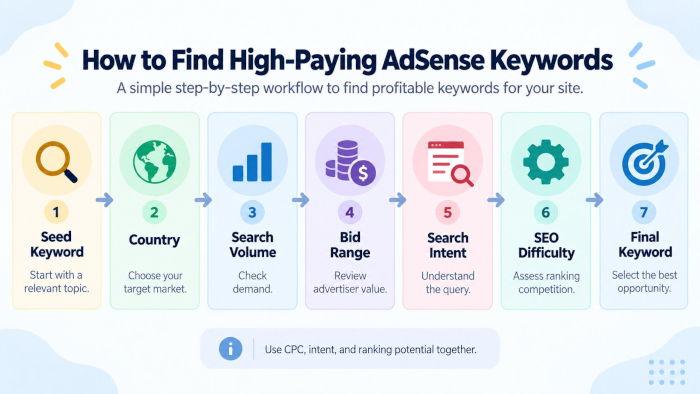
- Start with a seed topic you already know well, not the highest-CPC niche you can find. A keyword list only helps if you can write good content on it.
- Set your target country correctly in Keyword Planner. CPC, volume, and competition all shift by geography. US data won’t reflect demand in, say, India or the Philippines.
- Review average monthly searches for each idea, but don’t chase volume alone. A keyword with modest volume and strong buyer intent often beats a high-volume, low-intent term.
- Check the Competition column to gauge advertiser demand. Remember, it measures paid competition, not organic difficulty.
- Note the top-of-page bid low and high range as your commercial-value signal. A wide range often means thin auction data. A narrow, high range often means steady advertiser demand.
- Build out commercially relevant long-tail phrases around your seed topic. These often convert better and are easier to rank for than short head terms.
Check the real intent behind each keyword by seeing what currently ranks for it. A term that looks commercial on paper can still be dominated by informational content, or the reverse. - Check organic ranking difficulty separately. Use an SEO tool’s keyword difficulty metric, or look at the backlinks and content depth of the current top ten results.
- Cross-check your shortlist against your site’s real subject depth. A keyword you can write about with true expertise beats a higher-CPC keyword where you’d have to fake it.
- Revisit your keyword and CPC data now and then. Auctions shift with the economy, the season, and advertiser budgets, so a list built a year ago may be stale.
Tools like Ahrefs or Semrush can add organic-specific metrics that Keyword Planner doesn’t offer, since it’s built for advertisers. Think a keyword difficulty score, or content-gap analysis. Neither tool is required to do this well. Keyword Planner is free with a Google Ads account, and you don’t need an active campaign to use it. It also draws on much of the same auction data that paid tools report.
CPC, CPM, eCPM, and RPM in Plain English
These four terms get mixed up all the time. Here’s what each one measures, and who it’s for.
CPC, cost per click, is what an advertiser pays each time someone clicks their ad. It’s an advertiser-side number, and it’s the figure behind Keyword Planner and most “expensive keywords” articles, including the niche breakdowns above.
CPM, cost per mille, is what an advertiser pays for one thousand ad impressions, no matter how many clicks happen. It’s used mainly for display and brand-awareness ads, not search ads.
eCPM, effective cost per mille, is the actual revenue a publisher earned, shown per thousand impressions, no matter what pricing model produced it underneath. The formula is simple: divide total earnings by total impressions, then multiply by 1,000. This is the metric AdSense uses to pay out for AdSense for Content.
RPM, revenue per mille, is Google’s own AdSense term for close to the same math, applied at different levels of a site. Page RPM divides your estimated earnings by page views, not just ad impressions, then multiplies by 1,000. That gives you a sense of what each page view across your whole site is worth, even pages where an ad didn’t load or get clicked. Google’s own AdSense Help page gives this example: if you earned an estimated $180 from 45,000 ad impressions, your RPM would be $4.00.
For most publishers, page RPM is the more useful number day to day. It reflects how a whole page performs, not just one ad’s price.
Why Keyword Value Differs by Country
The same keyword can carry a very different CPC depending on where the searcher lives. That means a different AdSense RPM too, for a publisher whose traffic comes from that country.
The United States is the reference market for most of the data here, and for good reason. It has the deepest advertiser budgets and the busiest auctions for most topics in this article. The UK, Canada, and Australia often follow with somewhat lower, but still real, advertiser demand in similar English-language niches. That gap comes from market size, spending power, and industry structure. It has nothing to do with how AdSense itself works. India has huge search volume in English-language niches. Average CPCs there have run lower in the past, since advertiser budgets per customer tend to be smaller than in the US or UK.
This isn’t a reason to avoid non-US readers. It’s a reason not to assume a US CPC figure will carry over to a site with a different audience. Picture a site with mostly South or Southeast Asian traffic, in a high-US-CPC niche like insurance or law. That site will likely see lower AdSense RPM than the CPC data alone suggests, even with strong content and rankings. If your audience isn’t mostly American, treat every US-sourced CPC figure here as a ceiling, not a promise. The same goes for any other “high CPC keywords” list you find.
How We Selected These Keywords
The keyword examples above came from three kinds of sources. Live Google Keyword Planner pulls reported by ppc.io and Publift, dated July 2026 and April 2026. Ahrefs’ most expensive keywords study, last updated September 1, 2026. And WordStream by LocaliQ’s 2026 Google Ads industry benchmarks. All Keyword Planner figures use US targeting unless we’ve noted otherwise.
We favored niches where data lined up across more than one source. We left out figures that looked inconsistent. Ahrefs’ broader keyword lists, for example, mixed real legal and financial terms with obvious noise. Think brand names, pop-culture searches, and single-word fragments, all sharing the same round-number CPC. That pattern looks like an estimation quirk, not a real bid. We used that dataset for its industry breakdown, where legal services made up 17.52% of the 10,000 most expensive keywords studied. We did not use it for individual keyword picks.
You’ll also find near-identical “most expensive keywords” lists on many sites that trace back to one study last refreshed years ago. We didn’t reuse those older numbers here.
Every CPC and bid figure in this article is a snapshot. Google Ads auctions reprice constantly with advertiser budgets, the season, and competition. A number accurate in July 2026 will drift, sometimes a lot, within a few months. Check current figures in Keyword Planner before making a content or monetization decision based on any specific dollar amount here.
Frequently Asked Questions
What are high paying AdSense keywords?
They’re keywords and topics that draw high advertiser cost-per-click bids on Google Ads. This usually happens in industries with high customer lifetime value, like legal services, insurance, and B2B software. A high advertiser CPC signals commercial value in a topic. It’s not a specific AdSense payout.
Which niches tend to have the highest advertiser CPC?
Legal services, insurance, and personal finance rank among the highest. So do B2B software and SaaS, cybersecurity, and real estate lead-generation keywords. This holds up across Keyword Planner and industry benchmark data through 2026.
Does a high CPC keyword guarantee higher AdSense earnings?
No. AdSense pays an effective cost per mille per impression. Your actual RPM depends on visitor country, traffic quality, ad viewability, device type, and several other factors beyond the keyword itself.
How do I find high CPC keywords for my blog?
Google Keyword Planner is the most direct source. Set the correct target country, check top-of-page bid ranges alongside search volume, and check organic SEO difficulty on its own, since Keyword Planner doesn’t measure that.
Which countries generally have stronger advertiser demand?
The United States has the deepest advertiser budgets in most English-language niches, followed by markets like the UK, Canada, and Australia. High search volume in a country doesn’t always mean a high CPC there.
Is Google Ads CPC the same as AdSense earnings?
No. CPC is the price an advertiser pays Google in an auction. AdSense pays publishers a share of ad revenue per impression instead. That share is roughly 68% when a display ad is bought through Google Ads. It’s 51% for AdSense for Search. Both figures come from Google’s own AdSense Help pages.
Does adding high CPC keywords increase AdSense revenue?
Not by itself. Mentioning expensive keywords doesn’t make premium ads appear or raise your rates. AdSense serves ads based on page content, audience, and overall advertiser demand, not by matching specific words you’ve typed.
How often should CPC keyword data be updated?
Treat any specific CPC or bid figure as good for a few months at most. Google Ads auctions shift with advertiser budgets and the season, so check current data in Keyword Planner before acting on older numbers.


Hey thanks for the keywords, some of them are really helpful which I was ignorantly missing out.
Thanks a lot for sharing, it’s very helpful.. The high CPC keyword was “Mesothelioma“. This keyword was worth of $100 per click. You can earn from the Google Adsense High CPC Keywords by using them in your post and can write articles on those keywords.