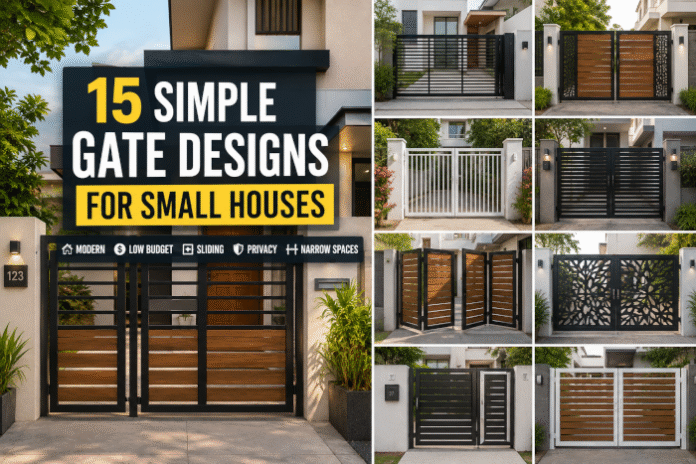
Choosing a gate for a small house is mostly about making good use of the available entrance space. A design that looks suitable in a photo may not work well if the driveway is short, there is no room for a swing gate, or more privacy is needed.
The practical choice depends on the entrance width, available opening space, pedestrian and vehicle access, material, maintenance, privacy, and budget.
Below are 15 simple gate designs for small houses, including sliding, swing, folding, single-leaf, privacy, and low-budget options. The quick comparison can help you narrow down the right opening style before choosing a specific design.
Quick Guide: Which Gate Type Works Best for a Small House?
| Gate Type | Best For | Space Requirement | Privacy | Budget Level |
|---|---|---|---|---|
| Sliding gate | Short driveways and limited swing clearance | Needs clear space along one side | Low to high, depending on panels | Medium |
| Single swing gate | Narrow entrances | Needs a clear swing arc | Low to high | Low to medium |
| Double swing gate | Wider vehicle entrances | Needs opening clearance for both leaves | Low to high | Low to medium |
| Folding gate | Entrances with limited swing and side space | Panels fold into a smaller area | Medium to high | Medium |
A sliding gate saves driveway depth but still needs enough lateral space to move alongside the boundary. A swing gate is mechanically simpler but requires a clear opening arc. Folding gates are worth considering when neither a full swing nor a conventional sliding arrangement fits comfortably.
15 Simple Gate Designs for Small Houses
1. Simple Iron Gate Design
A basic iron or mild-steel gate is one of the most adaptable choices for a compact home. Straight vertical bars, a rectangular frame, and limited decorative work keep the design visually light while avoiding unnecessary fabrication.
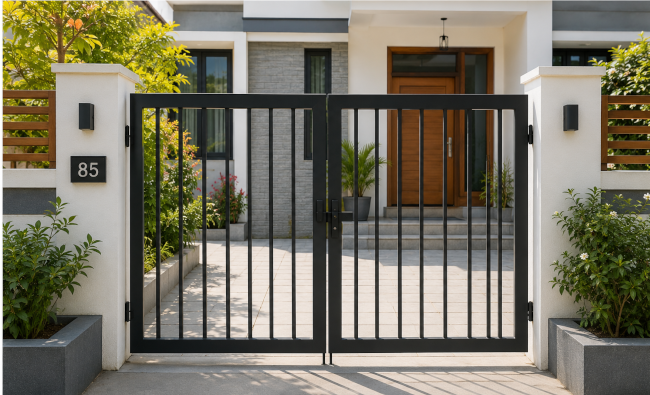
An open-bar design also allows the front of the house or garden to remain visible. If more privacy is required, partial metal panels or closer spacing can be incorporated into the design.
Metal gates exposed to rain and humidity need a suitable protective finish, particularly if the coating becomes damaged.
Best for: Everyday front entrances
Material: Iron or mild steel
Opening style: Single or double swing
Privacy: Low to medium
Budget level: Low to medium
2. Modern Horizontal Slat Gate
Horizontal metal slats work well with modern small houses because the pattern is simple and does not depend on elaborate decorative elements.
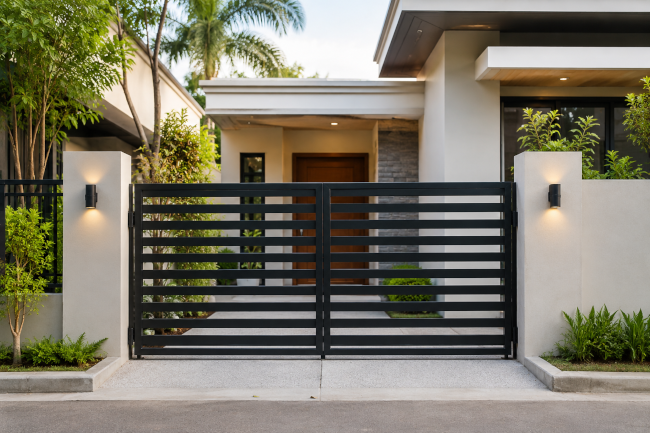
The spacing between the slats changes how open or private the gate feels. Wider gaps retain visibility and airflow, while closer slats provide more screening from the street.
A horizontal-slat gate can be built as a swing or sliding gate, making the style suitable for different entrance layouts. For a compact facade, keep the frame and slat pattern proportionate rather than making the gate unnecessarily tall or visually heavy.
Best for: Modern compact homes
Material: Steel or aluminium
Opening style: Swing or sliding
Privacy: Medium to high
Budget level: Medium
3. Low-Budget Metal Gate
A simple welded metal gate can be a practical low-budget option when decorative work is kept to a minimum. A rectangular frame with vertical or horizontal members generally requires less complicated fabrication than gates with curves, ornamental scrollwork, or detailed cut panels.
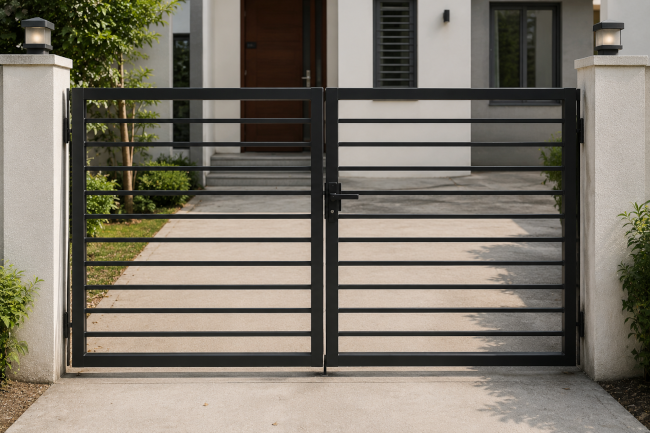
Straightforward construction can also make future repairs or refinishing easier.
Saving money should not mean compromising the basic structure. The frame, hinges, supports, and locking arrangement still need to suit the gate’s dimensions and weight.
Best for: Cost-conscious homeowners
Material: Mild steel
Opening style: Single or double swing
Privacy: Low to medium
Budget level: Low
4. Sliding Gate for a Narrow Driveway
A sliding gate is useful when a car parks close to the entrance or there is not enough driveway depth for a traditional gate to swing comfortably.
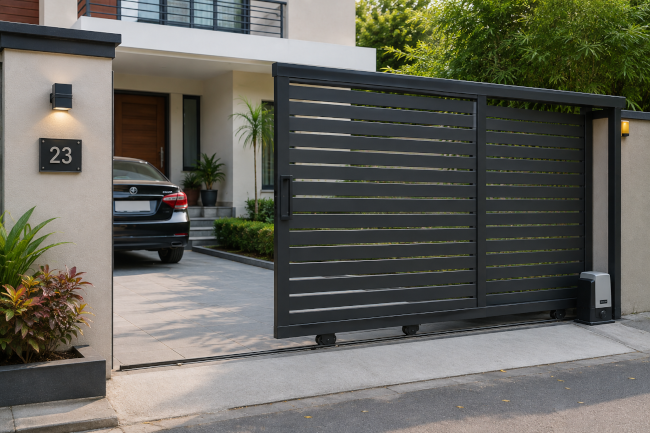
Instead of moving inward or outward, the gate travels sideways along the boundary. This keeps the area immediately behind the gate clear while it opens.
The main limitation is lateral space. A conventional sliding gate needs an unobstructed section beside the opening where the gate can move. Track-based systems also need the running area to remain reasonably clean and properly maintained.
Best for: Short driveways and limited swing clearance
Material: Steel, aluminium, or a metal-and-wood combination
Opening style: Sliding
Privacy: Low to high
Budget level: Medium
5. Single Gate Design for a Small Home
For a narrow front entrance, one swing leaf may be simpler than splitting the opening into two smaller gates.
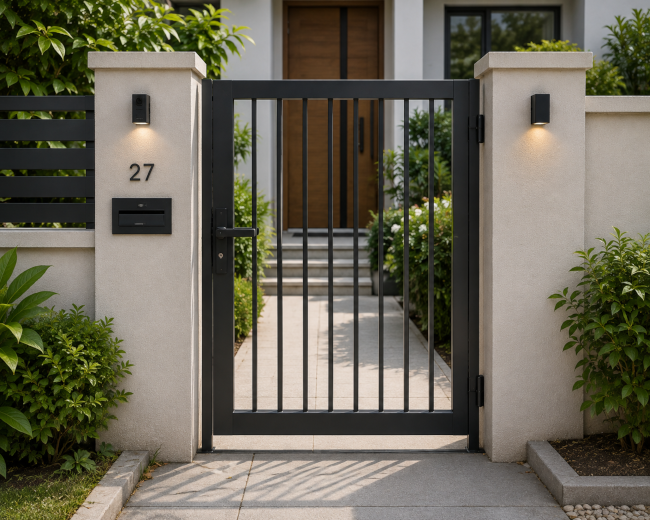
A single gate works particularly well for pedestrian entrances, smaller vehicle openings, and compact boundary walls. The design can remain visually open with vertical metal bars or provide more screening with partial panels.
The main consideration is the swing arc. Before choosing a single leaf, check that it can open fully without hitting a parked vehicle, step, planter, or other obstruction.
As an entrance becomes wider and the gate heavier, a double-leaf or sliding arrangement may be more practical.
Best for: Narrow entrances
Material: Steel, iron, aluminium, or wood and metal
Opening style: Single swing
Privacy: Low to high
Budget level: Low to medium
6. Wood and Metal Combination Gate
A metal frame with timber or wood-look infill provides the warmth of a wooden gate without relying entirely on wood for the supporting structure.
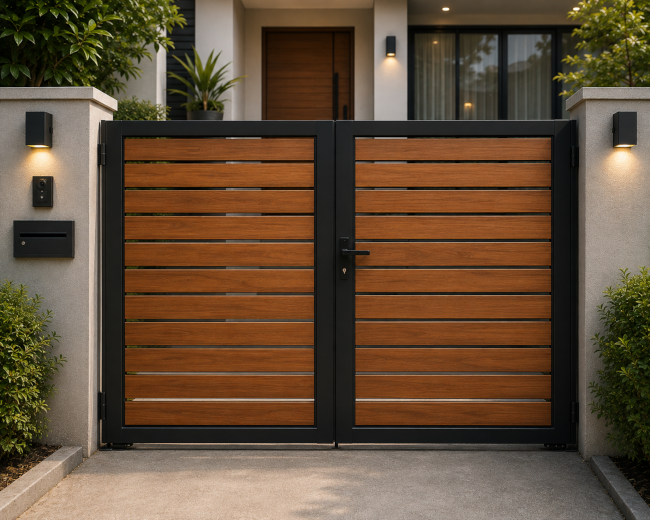
This combination works with modern, transitional, and traditional house facades. Depending on how closely the boards or slats are positioned, it can also provide considerably more visual privacy than an open iron gate.
Outdoor wood requires suitable finishing and maintenance, and its condition over time depends on the species, finish, and exposure to sun and moisture. Wood-look alternatives can provide a similar appearance with different maintenance requirements.
Best for: Homes needing warmth and privacy
Material: Metal frame with wood or wood-look infill
Opening style: Swing or sliding
Privacy: Medium to high
Budget level: Medium to high
7. Simple Steel Gate
A steel gate with clean lines is a good option when straightforward construction matters more than decorative detailing.
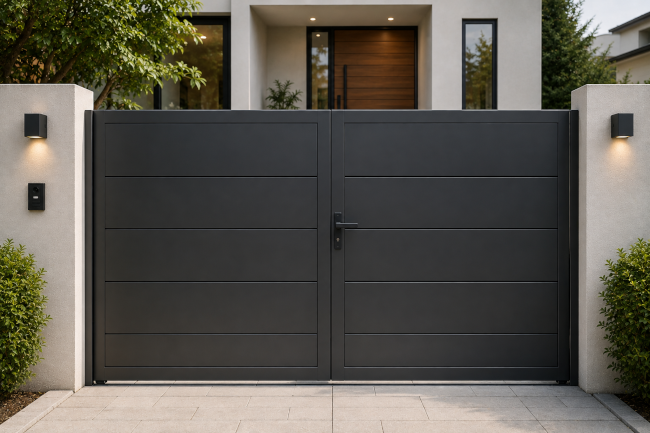
For a small home, rectangular sections or restrained geometric patterns usually suit the scale better than a large ornamental gate. Steel can also support a range of layouts, from open bars to semi-private slats and solid panels.
Maintenance depends heavily on the type of steel and protective finish. Mild-steel gates, in particular, need suitable corrosion protection.
Best for: Practical modern entrances
Material: Steel
Opening style: Swing or sliding
Privacy: Low to high
Budget level: Medium
8. Solid-Panel Privacy Gate
If the front door, seating area, or ground-floor windows are directly visible from the road, a solid or mostly solid gate can provide more visual screening.
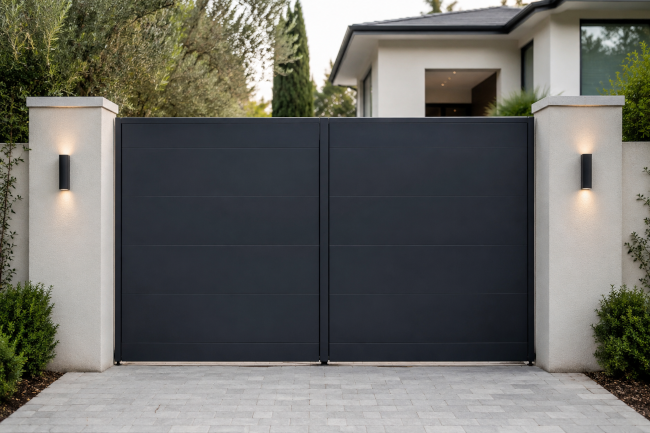
Metal sheet panels, closely spaced slats, or wood-look panels can all create a privacy-focused entrance. A completely solid gate also has more visual weight, so a simple pattern and restrained colour generally work better on a narrow frontage.
Solid surfaces can be more affected by wind than open-bar designs, so the frame, hinges, supports, and installation need to suit the gate’s size and construction.
Best for: Homes facing busy streets
Material: Steel, aluminium, or metal with infill panels
Opening style: Swing or sliding
Privacy: High
Budget level: Medium
9. Minimal Black Metal Gate
A black metal gate with thin vertical or horizontal members is a straightforward way to create a modern entrance without complicated fabrication.
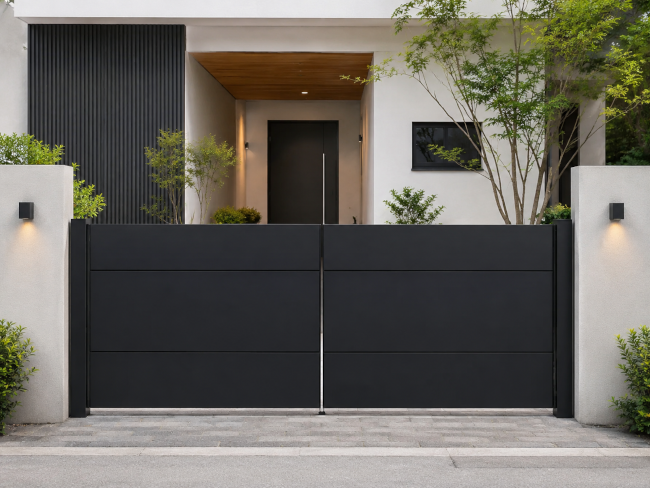
The dark finish works well when the house exterior already includes white, grey, brick, concrete, or natural-wood tones. Instead of relying on ornamental details, the appearance comes from proportions, spacing, and alignment with the boundary wall.
An open version provides visibility through the gate, while sheet panels or closely spaced slats can be added where more privacy is needed.
- Best for: Contemporary small houses
- Material: Coated metal
- Opening style: Swing or sliding
- Privacy: Low to medium
- Budget level: Low to medium
10. Traditional Iron Gate
A traditional iron gate does not have to be heavily ornamented. A few restrained curves, vertical members, or decorative details can provide a more classic appearance without making a small entrance look overcrowded.
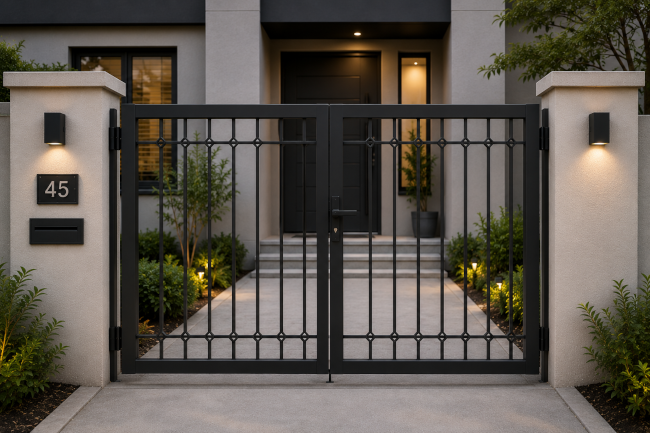
This style works well with homes that use brick, stone, columns, or other traditional exterior elements.
Open ironwork provides limited privacy, so homeowners who want more screening can combine decorative upper sections with simpler solid panels below. Intricate metalwork may also increase fabrication and maintenance requirements.
Best for: Traditional house exteriors
Material: Iron or fabricated steel
Opening style: Single or double swing
Privacy: Low to medium
Budget level: Medium
11. Main Gate With a Small Pedestrian Door
A vehicle gate with separate pedestrian access can be useful when people enter and leave the house more frequently than a car does.
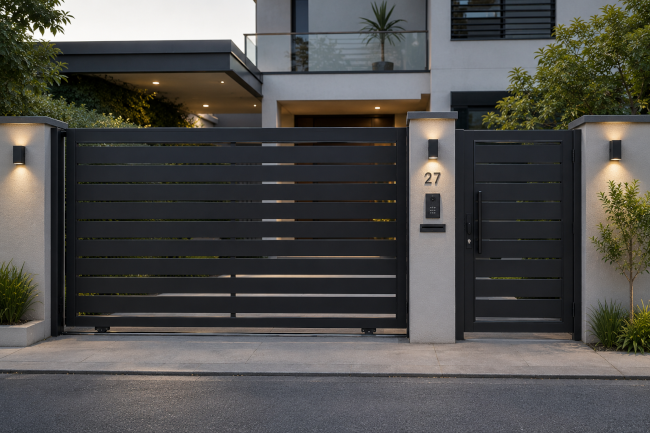
The smaller door may be positioned beside the main gate or incorporated into the overall entrance layout. This avoids opening the full vehicle gate every time someone enters on foot.
For compact homes, keeping the pedestrian gate visually consistent with the main gate helps the frontage feel coordinated. The layout should also allow comfortable pedestrian movement without interfering with vehicle access.
Best for: Homes with frequent pedestrian access
Material: Steel, aluminium, or combination materials
Opening style: Main gate plus pedestrian gate
Privacy: Medium to high
Budget level: Medium
12. Folding Gate for Limited Space
A folding or bi-fold gate divides the entrance into panels that fold together as the gate opens. Because each section is shorter than a full gate leaf, the design can work where a large swing arc would be inconvenient.
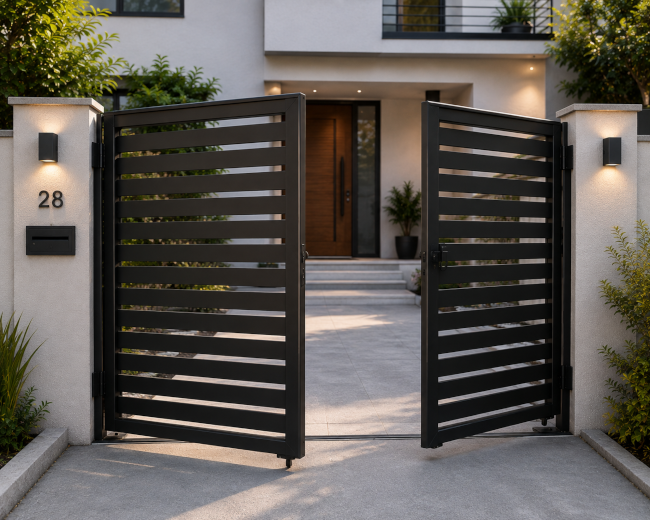
It may also be useful where there is not enough uninterrupted boundary length for a conventional full-width sliding gate.
The mechanism is more complex than a basic hinged gate, so proper alignment, hardware, and installation matter. On a small frontage, simple metal frames or slats can keep the design from appearing too busy.
Best for: Tight entrances
Material: Steel or aluminium
Opening style: Folding or bi-fold
Privacy: Medium to high
Budget level: Medium
13. Boundary Wall and Gate Combination
Sometimes the most suitable small-house gate design comes from treating the gate and boundary wall as one composition instead of selecting them separately.
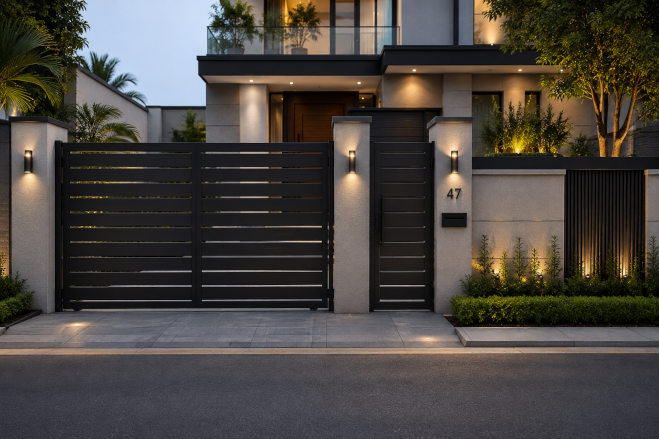
Repeating the same horizontal lines, colours, or materials across both elements can make a narrow frontage appear more organised. For example, a simple metal-slat gate can continue a pattern used on sections of the boundary wall.
This approach is especially useful when the front elevation already contains several materials or colours. A quieter gate-and-wall combination prevents the entrance from competing with the house itself.
Best for: Compact street-facing facades
Material: Depends on the wall and gate design
Opening style: Swing or sliding
Privacy: Adjustable
Budget level: Medium
14. Simple White Gate
A white gate can suit cottages, light-coloured contemporary homes, and houses with small landscaped front areas.
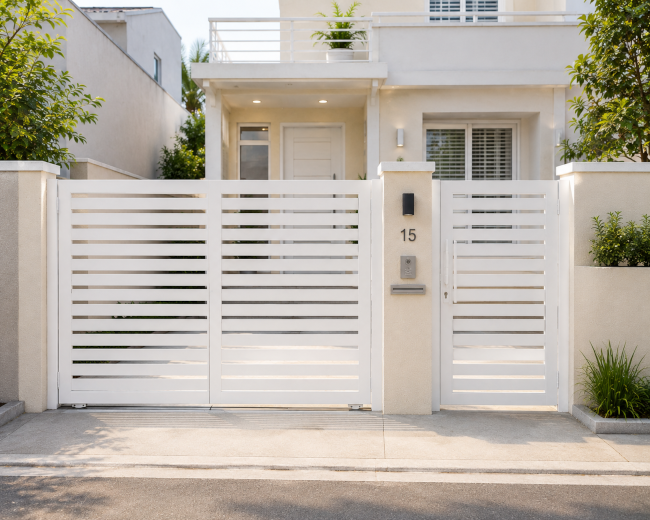
The design works best when the form remains simple. Vertical bars, straightforward slats, or a restrained frame are usually enough. A light finish can also make a compact entrance feel less visually heavy than a large, dark, solid gate, although the final effect depends on the surrounding wall and facade.
Marks and surface deterioration may be easier to notice on a light finish, so coating quality and routine cleaning matter.
Best for: Light-coloured or cottage-style facades
Material: Coated steel, aluminium, or suitable exterior-grade material
Opening style: Single or double swing
Privacy: Low to medium
Budget level: Low to medium
15. Modern Laser-Cut Gate
Laser-cut metal panels can add pattern to a modern gate without using traditional scrollwork or heavy ornamentation.
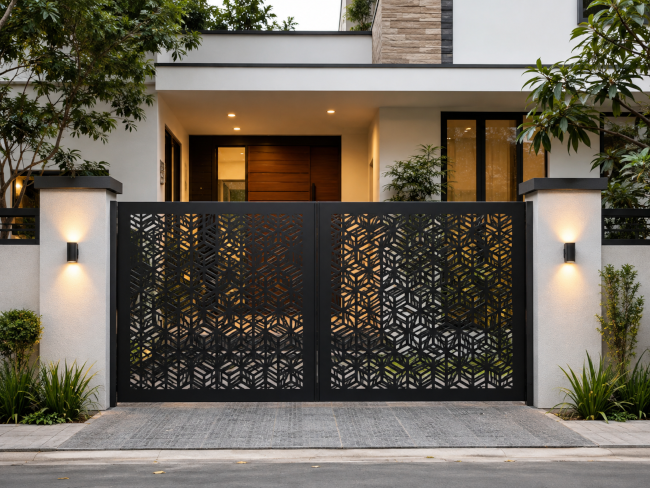
For a small house, a restrained geometric pattern usually works better than an extremely detailed design. The panel can cover the entire gate for greater screening or be used as an accent within a simpler metal frame.
Privacy depends on the size and density of the openings. Detailed custom patterns and additional fabrication may also increase costs, so this style is generally less suited to the lowest-budget projects.
Best for: Modern feature entrances
Material: Fabricated metal panels
Opening style: Swing or sliding
Privacy: Medium to high
Budget level: Medium to high
Best Gate Designs for Narrow Spaces
For a narrow or constrained entrance, start with the opening mechanism rather than the decorative style.
A sliding gate is useful when driveway depth is limited because it moves sideways instead of sweeping across the space behind the entrance. It does, however, need enough clear boundary length beside the opening.
A folding gate can work when both the swing area and available side space are restricted. Its shorter connected panels fold into a more compact area.
A single-leaf gate may be the simplest option for a narrow pedestrian or smaller vehicle entrance, provided there is enough room for it to swing.
A narrow entrance does not automatically require a sliding gate. Check both the space behind the entrance and the available wall length beside it before deciding.
Low-Budget Simple Gate Designs for Small Houses
A low-budget gate usually benefits from simple construction rather than cheaper materials alone.
A straightforward welded steel frame with vertical bars or uncomplicated horizontal members can reduce fabrication complexity. Standard shapes generally require less work than detailed curves, laser-cut patterns, custom ornamental sections, or mixed materials.
Ways to keep the design economical include:
- Limiting decorative elements
- Using a single leaf where the entrance and gate weight make it practical
- Choosing a simple manual opening system
- Avoiding unnecessary automation
- Using a basic but suitable protective finish
- Designing around standard material sections where appropriate.
The cheapest initial option is not always the cheapest to maintain. Poor fabrication, unsuitable hardware, or inadequate corrosion protection can create repair problems later. Compare the complete gate, finish, and installation rather than appearance alone.
Which Gate Material is Best for a Small House?
There is no single material that works best for every home. Climate, required privacy, gate size, maintenance expectations, and budget all affect the decision.
| Material | Main Advantage | Main Consideration | Maintenance | Typical Budget Level |
|---|---|---|---|---|
| Mild steel | Easy to fabricate into many designs | Requires corrosion protection | Medium | Low to medium |
| Wrought-iron style metalwork | Suits decorative and traditional designs | Detailed work can add weight and upkeep | Medium to high | Medium |
| Aluminium | Lightweight and resistant to rust | Profile choice affects rigidity and cost | Low | Medium to high |
| Wood | Warm appearance and good privacy | Weather exposure can affect the material and finish | Medium to high | Medium to high |
| Wood and metal | Combines a structural metal frame with a wood appearance | Different materials may have different maintenance needs | Medium | Medium to high |
Mild Steel
Mild steel is well suited to simple welded frames, bars, slats, and panels. It is particularly useful when affordability and fabrication flexibility matter. Its main weakness is corrosion if the protective finish fails.
Wrought-Iron Style Gates
Decorative ironwork suits traditional homes but is usually less appropriate when the goal is the simplest possible low-maintenance gate. Extra scrollwork and detailing can increase both fabrication and refinishing work.
Aluminium
Aluminium is lighter than many steel constructions and does not rust in the same way as iron-based materials. It works well for clean slat and panel designs. The profiles and fabrication still need to suit the size and function of the gate.
Wood
Wood provides natural texture and can create strong visual privacy. Outdoor exposure means timber selection and finish matter, and maintenance may be required depending on local weather and how exposed the gate is.
Wood and Metal
A metal structure with wood or wood-look infill is a practical compromise when you want the visual warmth of timber with a separate supporting frame. It works particularly well for modern privacy gates.
Sliding Gate vs Swing Gate for a Small House
The better option depends primarily on where the gate has room to move.
Sliding Gate
A sliding gate moves horizontally along the boundary rather than swinging into the driveway.
Advantages:
- No swing arc across the driveway
- Useful when a vehicle parks close to the gate
- Suitable for many wider vehicle entrances
- Can use open bars, slats, or solid privacy panels
Limitations:
- Needs clear lateral space beside the entrance
- Track-based systems require the running area to remain clean and aligned
- Fabrication and hardware may be more involved than a basic swing gate
Swing Gate
A swing gate rotates on hinges and may use one or two leaves.
Advantages:
- Mechanically straightforward
- Suitable for many simple, low-budget designs
- Easy to operate manually
- Works well for narrow to moderate entrances with sufficient clearance
Limitations:
- Requires a clear swing arc
- Parked vehicles, steps, landscaping, or a rising driveway can interfere with opening
For a short driveway, a sliding gate often makes better use of the available depth. Where there is enough clear opening space and the goal is simplicity, a swing gate can be the more straightforward choice.
How to Choose the Right Gate for Your Home
Before choosing a design from a photo, check the practical requirements of the entrance.
Entrance width: Determine whether the opening is mainly for pedestrians, a vehicle, or both.
Opening space: Check both the swing area inside the property and the available boundary length beside the entrance.
Vehicle access: Consider where the car stops while the gate is being opened and whether the gate reduces usable driveway space.
Pedestrian access: If people frequently enter on foot, a separate smaller gate may be more convenient.
Privacy: Open bars preserve visibility, closely spaced slats provide partial screening, and solid panels provide greater visual privacy.
Material: Choose according to budget, appearance, climate, and expected maintenance rather than appearance alone.
Maintenance: Consider coatings, moving hardware, tracks, wood finishes, and other surfaces that may need attention over time.
Climate: Rain, humidity, coastal conditions, and strong sun can affect how different materials and finishes age.
House style: A compact contemporary home generally suits a simpler gate than a heavily ornamental design.
Manual or automated: Automation can add convenience, but it also adds equipment, installation, and maintenance. It is not necessary for every small house.
Frequently Asked Questions
Which gate design is best for a small house?
The best design is one that fits the available opening space. Sliding gates suit short driveways, while single or double swing gates work well where there is enough clearance.
Which gate is best for a narrow entrance?
For a genuinely narrow opening, a compact single-leaf gate may be sufficient. If limited driveway depth is the main problem, a sliding or folding gate may work better.
What is the most affordable simple gate design?
A basic mild-steel frame with straightforward vertical or horizontal members is often one of the more budget-friendly approaches because it avoids complex decorative fabrication. Actual cost still depends on size, material specification, finish, labour, and location.
Is a sliding gate better than a swing gate?
Neither is automatically better. Sliding gates save swing clearance but require space along the boundary. Swing gates are simpler but need enough room for the leaves to open fully.
Which gate material requires less maintenance?
Aluminium generally requires relatively little maintenance compared with exposed natural wood or poorly protected ferrous metal. Actual maintenance depends on material grade, coating, climate, and installation.
Can a main gate include a small pedestrian door?
Yes. Pedestrian access can be provided through a separate gate beside the vehicle entrance or incorporated into the overall gate system where the design allows.
Which gate design provides the most privacy?
Solid-panel gates and designs with closely spaced slats provide more visual privacy than open-bar gates. The amount of screening can be adjusted according to how much visibility and airflow you want.
Final Thoughts
The right gate for a small house does not need to be complicated. Start with the entrance width and available opening space, then consider privacy, material, maintenance, and budget.
Sliding and folding systems can make better use of constrained entrances, while a single or double swing gate remains practical where there is enough clearance. Once the opening style is settled, choose a design that complements the scale and exterior of the house.

