Sending a package from the Philippines to the USA is easier than many people expect, but it involves a few important decisions: which carrier to use, how to pack and declare the item, and what the shipment will cost. This guide covers those points in plain language, including the recent change to US customs rules that affects most incoming shipments.
The process for shipping from the Philippines to other countries is similar. That is covered briefly near the end, but the USA is the main focus here.
Quick Answer: Shipping From the Philippines to the USA
- For light personal parcels or documents, PHLPost is usually the cheapest option, although it is slower and has experienced service interruptions.
- For faster delivery and tracking, DHL Express, FedEx, and UPS are the main international couriers operating in the Philippines. They cost more but offer more predictable service.
- For large, heavy, or commercial shipments, air or sea freight through a forwarder may make more sense than a parcel courier.
- As of August 2025, the US removed its $800 duty-free allowance for incoming shipments. Most packages can now be subject to duty regardless of value, although a limited exception remains for qualifying gifts worth $100 or less.
- There is no single cheapest or best service. The right option depends on weight, size, delivery speed, destination, and what is inside the package.
Shipping Options From the Philippines to the USA
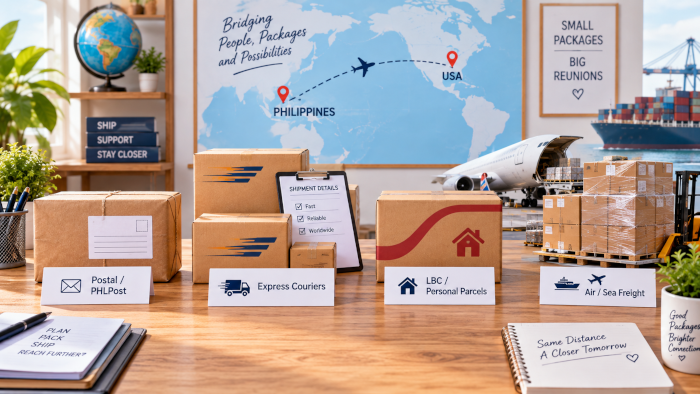
PHLPost
PHLPost is the Philippine national postal service and typically one of the lowest-cost ways to send letters, documents, and small parcels abroad. It is a reasonable choice if you are not in a hurry and the item is not especially valuable.
PHLPost suspended acceptance of mail and parcels bound for the US in August 2025 after the US ended its duty-free allowance for low-value shipments. Service was gradually restored, and PHLPost announced the full resumption of US-bound letters and parcels in April 2026 after introducing a customs declaration system that calculates duties and taxes at the point of mailing.
Postal services can still be affected by operational or international disruptions. Check current PHLPost advisories before going to the post office.
DHL Express
DHL has a large presence in the Philippines and is commonly used for both personal and business shipments to the US. It offers tracked, door-to-door delivery and generally moves faster than postal mail, although it costs more.
DHL is a practical option when reliable tracking or a faster delivery window matters.
FedEx
FedEx operates in the Philippines with international express services similar to DHL. It works for both personal shipments and business exports, particularly when you want detailed tracking and a more predictable delivery window.
Rates and available services depend on package weight, dimensions, destination, and delivery speed.
UPS
UPS also serves the Philippines-to-US route with international shipping options. Like DHL and FedEx, it is better suited to shipments where tracking and delivery speed matter more than obtaining the lowest possible price.
LBC Express
LBC is a well-known Philippine courier and also provides outbound international shipping services, including shipments to the US.
It can be worth checking LBC’s current rates for personal parcels, especially if you already use its services, although it is less commonly associated with Philippines-to-US shipping than with shipments moving in the opposite direction.
Air or Sea Freight
If you are shipping something large, heavy, or commercial, such as inventory, furniture, or several boxes at once, a freight forwarder may make more sense than a parcel courier.
Air freight is faster but more expensive per kilogram. Sea freight is much slower, often taking weeks rather than days, but can be considerably cheaper for bulky or heavy shipments.
Freight shipments also involve more formal customs paperwork than a typical personal parcel.
Philippines to USA Shipping Comparison
| Method | Best For | General Cost Level | Typical Speed | Tracking | Main Limitation |
|---|---|---|---|---|---|
| PHLPost | Light parcels, documents, non-urgent gifts | Lowest | Slowest, with postal transit plus customs | Limited, improving | Has experienced service suspensions |
| DHL Express | Personal or business shipments needing speed | Mid to high | A few business days | Full tracking | Higher cost than postal shipping |
| FedEx | Personal and business express shipments | Mid to high | Fast | Full tracking | Higher cost than postal shipping |
| UPS | Personal and business express shipments | Mid to high | Fast | Full tracking | Higher cost than postal shipping |
| LBC Express | Personal parcels | Mid | Moderate | Available | Less commonly used in this direction |
| Air/Sea Freight | Bulk, heavy, or commercial shipments | Varies by weight and volume | Air: days, Sea: weeks | Depends on forwarder | Not practical for a single small parcel |
Exact rates are not listed because they change and depend heavily on weight, dimensions, destination, and service level. Use the comparison to narrow down the type of service that fits your shipment, then request a quote from the provider.
How Much Does Shipping From the Philippines to the USA Cost?
There is no fixed price for shipping a package from the Philippines to the USA. Your actual cost depends on:
- Actual package weight
- Dimensional weight, particularly for bulky but lightweight packages
- Package dimensions
- Destination, including the US state or ZIP code
- Carrier and service level
- Declared value
- Insurance, if added
- Fuel surcharges
- Customs duties and taxes
Because customs duties now apply more broadly than before, budgeting for a shipment in 2026 may involve more than the carrier’s shipping fee.
For an accurate price, weigh and measure your package and request a quote directly from the carrier.
How Long Does Shipping From the Philippines to the USA Take?
Delivery time depends mainly on the shipping method.
- Postal shipping through PHLPost: Usually the slowest option. Transit can take one to several weeks, and customs processing may add more time.
- Express couriers such as DHL, FedEx, and UPS: Usually take a few business days for express services, depending on the destination and service selected.
- Air freight: Generally takes days, although consolidated freight can take longer to process than a standard express parcel.
- Sea freight: Often takes several weeks but is better suited to large or heavy shipments where cost matters more than speed.
Customs processing can delay any international shipment. Avoid promising the recipient an exact arrival date unless the carrier provides a guaranteed delivery service.
How to Send a Package From the Philippines to the USA
- Check whether the item can be shipped. Some goods are prohibited, restricted, or require additional documentation.
- Choose a shipping service based on your budget, delivery timeline, package size, and the value of the contents.
- Weigh and measure the package. Carriers use this information to calculate the shipping rate.
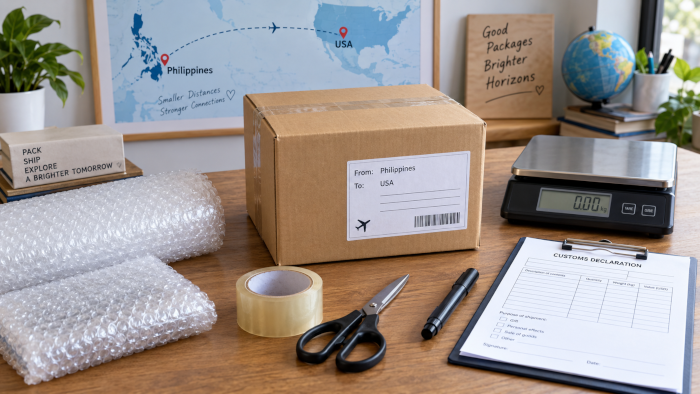
- Pack the item securely in a sturdy box with enough cushioning to prevent movement during transit.
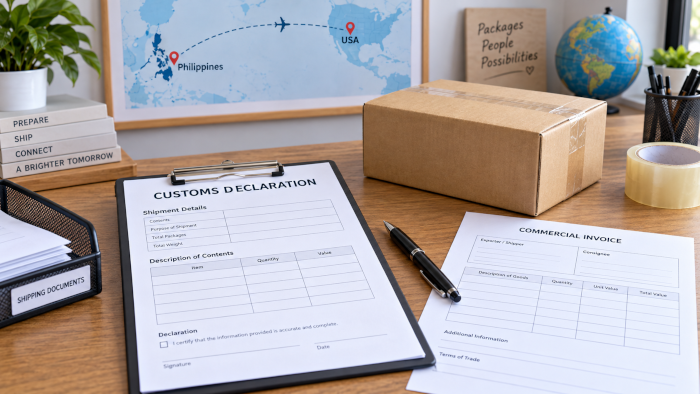
- Prepare the customs information. Even a small personal parcel normally requires a customs declaration.
- Declare the contents and value accurately. Under-declaring an item to reduce duty can cause delays, confiscation, or penalties.
- Compare rates from two or three carriers if the shipment is not urgent.
- Consider insurance if the contents would be expensive or difficult to replace.
- Ship the package and keep the receipt.
- Save the tracking number and share it with the recipient.
- Track the shipment until delivery and contact the carrier if tracking stops updating for an unusually long time.
Documents and Customs Requirements
The documents you need depend on what you are sending.
Personal Parcels
For gifts, clothing, and other personal items, you normally complete a customs declaration provided by the carrier or post office. It should accurately describe the contents and their value.
An ordinary personal parcel generally does not require the same commercial paperwork used for business exports.
Documents
Letters, certificates, and similar paperwork generally move with fewer customs requirements than physical goods. Postal services and international couriers offer document-specific shipping services for this purpose.
Commercial or E-commerce Shipments
Commercial shipments require more documentation. Typical requirements may include:
- Commercial invoice
- Packing list
- Airway bill for air shipments
- Appropriate Harmonized Tariff Schedule classification
- Product-specific permits or certificates when required
Businesses shipping regularly may benefit from working with the courier’s customs team or a licensed customs broker.
These commercial requirements should not be confused with the simpler process for sending an ordinary personal parcel or gift.
Duties and Taxes
US customs rules for low-value imports changed significantly in 2025.
Until August 2025, shipments valued at $800 or less generally entered the US duty-free under the de minimis exemption. On August 29, 2025, the US suspended that exemption for shipments from all countries, including the Philippines.
As a result, a package may now be subject to duty even when its value is well below $800.
For shipments moving through the international postal network, such as PHLPost, duty may be calculated according to the shipment’s value and the tariff treatment that applies to the goods and their country of origin. Because tariff rates and procedures can change, confirm the current requirements with the carrier or US Customs and Border Protection when you are ready to ship.
Gift Exception
A genuine gift sent from one private person to another may still qualify for duty-free treatment when its total value does not exceed $100 per recipient per day.
To qualify, the shipment needs to be a genuine unsolicited gift rather than something purchased or paid for by the recipient. It should also be correctly declared as a gift and sent as a person-to-person shipment rather than as part of a commercial transaction.
If the shipment exceeds the applicable gift allowance, duty may apply.
Commercial and e-commerce shipments do not qualify for the personal gift allowance and are subject to normal customs assessment.
Customs and tariff rules can change. For shipments with significant commercial or financial value, confirm current requirements with the carrier, customs authorities, or a customs professional before sending.
Items You Cannot or May Not Be Able to Ship
Restrictions vary by carrier, product, shipping method, and current customs regulations. Treat the following as a starting point rather than a complete legal list.
- Food and agricultural products: Fresh fruit, vegetables, fresh or cured meat, and other agricultural products may be restricted or prohibited because of pest and disease-control rules.
- Plants and seeds: These may require phytosanitary documentation or may be restricted.
- Medicines: Prescription and controlled medications can require documentation and may be restricted from international mailing.
- Alcohol and tobacco: These are heavily regulated and may face carrier restrictions, customs requirements, duties, or excise taxes.
- Lithium batteries: Many carriers treat lithium batteries as hazardous materials and impose packaging, quantity, or transportation restrictions.
- Aerosols and perfumes: These may face restrictions for air transport because of flammability rules.
- Weapons and replicas: Many cannot be sent through normal parcel services and may require government permits.
- Animal products: Certain leather, fur, wildlife-derived goods, and similar items may be restricted.
- Cash and currency: Carriers may restrict cash shipments, and declaration requirements can apply to significant amounts.
- Counterfeit goods: Counterfeit merchandise is prohibited.
If you are unsure about an item, check with the specific carrier before packing it. One courier may accept something that another refuses, and final customs clearance is determined by the relevant authorities.
How to Pack an International Package
- Use a new or sturdy box rather than a worn or damaged one.
- Leave enough room for protective padding around fragile items.
- Fill empty spaces so the contents cannot shift during transit.
- Seal all seams with proper packing tape.
- Describe items accurately on the customs declaration. For example, write “used clothing” rather than simply “gift.”
- Use a box that fits the contents reasonably well. Couriers often charge according to dimensional weight, so an unnecessarily large box can increase the shipping cost.
Cheapest Way to Ship From the Philippines to the USA
For small, lightweight, non-urgent packages, postal shipping through PHLPost is generally one of the lowest-cost options.
However, the cheapest service for a particular package depends on:
- Parcel size and weight
- Required delivery speed
- Declared value
- Insurance
- Destination
- Current carrier rates and surcharges
Express couriers cost more in many cases, but rates vary enough that it is still worth comparing quotes, especially for heavier packages.
The most reliable way to find the cheapest option is to enter the same package dimensions, weight, and destination into two or three carrier quote tools and compare the total cost.
Documents vs. Parcels vs. Commercial Goods
The type of shipment affects its customs requirements.
- Documents generally have the fewest customs requirements.
- Personal parcels and gifts need an accurate customs declaration and may qualify for the $100 gift exemption when the requirements are met.
- Commercial and e-commerce goods require additional customs documentation and are subject to standard duty assessment.
Identifying your shipment type before choosing a service can help you avoid preparing unnecessary paperwork or missing documents that are actually required.
Shipping From the Philippines to Other Countries
The same basic process applies when shipping from the Philippines to other countries: choose between postal, courier, or freight services, declare the contents accurately, and check the destination country’s customs requirements.
What changes are the destination country’s duty thresholds, prohibited-items rules, documentation requirements, and typical transit times.
Do not assume that US customs rules apply elsewhere. Check the destination country’s requirements before shipping.
Common Shipping Mistakes
- Under-declaring the value to try to reduce customs duty
- Assuming a shipping cost before weighing and measuring the package
- Failing to check restrictions on food, batteries, liquids, medicines, or other controlled items
- Choosing the cheapest service for an urgent shipment without checking the expected transit time
- Skipping insurance for valuable or difficult-to-replace items
- Using inadequate packaging for fragile or electronic goods
Frequently Asked Questions
How much does it cost to ship a package from the Philippines to the USA?
The cost depends on the package’s weight, dimensions, destination, carrier, service level, declared value, and possible customs charges. There is no fixed price, so get a quote for your specific package.
How long does shipping from the Philippines to the USA take?
Postal shipping can take one to several weeks, while express couriers such as DHL, FedEx, and UPS typically take a few business days. Customs processing can add time to either method.
What is the cheapest way to ship from the Philippines to the USA?
PHLPost is generally one of the cheapest options for small, lightweight, non-urgent parcels. Compare current quotes before shipping because rates vary by package.
Do I have to pay customs duty on a gift sent to family in the US?
A genuine unsolicited gift worth $100 or less per recipient may qualify for duty-free treatment when it is sent person-to-person and correctly declared as a gift. Duty may apply when the shipment does not meet those requirements or exceeds the applicable allowance.
Is PHLPost currently accepting parcels for the US?
PHLPost resumed full acceptance of US-bound mail and parcels in April 2026 after suspending the service in 2025. Check current PHLPost advisories before shipping because service conditions can change.
Do I need a commercial invoice to send a personal parcel?
An ordinary personal parcel generally does not require the same commercial invoice and customs documentation used for business shipments. You will still need to provide an accurate customs declaration.
What items can’t I ship to the USA?
Commonly restricted items include certain fresh foods and agricultural products, medicines, alcohol, tobacco, lithium batteries, aerosols, weapons, animal products, and counterfeit goods. Exact restrictions vary by carrier and product, so confirm the rules before shipping anything uncertain.

