This cue card asks you to describe a skill that you can teach other people, and the hardest part is often choosing a skill you can develop naturally for one to two minutes. The best choice is usually something you know well enough to explain with specific details, rather than something that simply sounds impressive. The article includes practical ideas, sample answers, a simple speaking structure, useful vocabulary, and related Part 3 questions to help you build your own response.
Describe a Skill That You Can Teach Other People
In IELTS Speaking Part 2, you are given a card with a topic and a few points to cover, along with one minute to prepare before you speak for one to two minutes. This topic is commonly reported by candidates in the following form.
- what the skill is
- how you learned it
- how you can teach it to other people
- how you feel about this skill
What Does This IELTS Cue Card Ask You to Talk About?
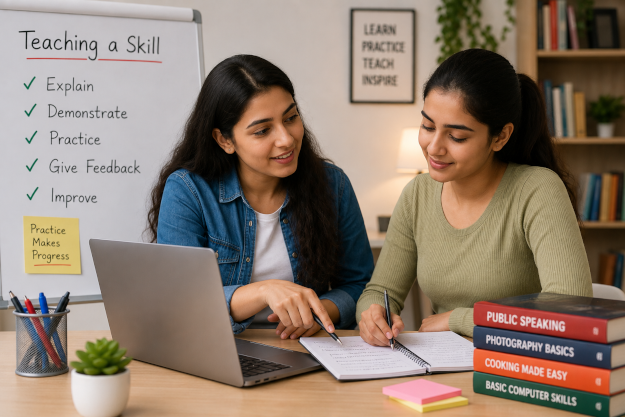
Each bullet point is asking for something slightly different, and treating them as four separate mini questions, rather than one vague topic, makes your answer far easier to organize.
What Is the Skill?
Choose one specific skill you can name and describe in detail, not a broad category. Something like cooking or basic guitar works better than a vague statement about having good skills in general and a skill you actually understand beats one that only sounds impressive. It does not need to be rare. Ordinary, familiar skills are usually easier to talk about in real detail.
How Did You Learn It?
Mention a real or realistic source, such as a family member, a teacher, a course, online videos, or simple practice on your own. Add one specific detail, like when, where, or who taught you, rather than a vague line such as “I learned it over time.”
How Can You Teach It to Others?
Describe an actual method, not just a claim that you would teach them everything. Mention showing someone the basics first, letting them practice, giving feedback, or breaking the skill into smaller steps. A specific approach also gives you a clearer way to explain the skill.
How Do You Feel About the Skill?
Give a genuine reason it matters to you: it is useful in daily life, it makes you feel confident, or it has practical value, like saving money or staying healthy. This bullet usually closes the answer, so keep it short rather than opening a new idea here.
Easy Skills You Can Choose for This Cue Card
If you are not sure what to talk about, pick something ordinary that you can describe from start to finish. Here are a few reliable options.
Cooking
Easy to talk about because everyone eats and most people already have an opinion about food. Mention one specific dish, who taught you to make it, and how you would show someone the steps in your own kitchen.
Photography
Photography is a practical option if you regularly use a phone or camera. Describe learning about composition and lighting through practice, and teaching someone by going out and taking photos together.
Drawing or Painting
Even casual experience with sketching or painting can give you enough material. Describe a specific technique you know, such as shading or mixing colors, and how you would demonstrate it step by step.
Public Speaking
Useful if you have given a presentation, spoken in class, or led a discussion before. Describe practicing in front of a small group and giving feedback on pace, tone, and body language.
Playing a Musical Instrument
A musical instrument is another straightforward choice. Mention a few chords or a simple song, and describe guiding a beginner through their first attempts patiently.
Basic Computer Skills
A strong choice if you already help friends or family with phones, laptops, or apps. Describe something concrete, like setting up an email account, using a spreadsheet, or organizing photos.
Gardening or Handicrafts
Good for a calmer, practical answer. Describe growing vegetables, sewing, or making something by hand, and showing someone the basic steps in person.
Describe a Skill That You Can Teach Other People: Sample Answer
One skill I can teach other people is cooking, especially a proper dal, which I learned mostly from my mother, though not in a formal way. I used to just stand in the kitchen and watch her when I was a teenager, and eventually she let me do small parts of it myself, like washing the lentils or adding the spices at the right time. It took a few failed attempts before I actually got the taste right.
If I were teaching someone, I would not just hand them a recipe and leave them to it. I would cook alongside them the first couple of times, show them how to judge the consistency by eye rather than by measuring everything exactly, and let them taste it as we go so they understand what needs adjusting. I think cooking is a genuinely useful skill to pass on because it is something people use every day, and being able to cook something properly gives you a real sense of independence.
A skill I can teach other people is playing the guitar, or at least the basics of it. I taught myself using online videos when I was around sixteen, and I practiced almost every day for maybe six months before I could play a full song without stopping. It was frustrating at first because my fingers hurt and I kept losing the rhythm, but I stuck with it because I really wanted to play a few songs I liked.
If I taught someone, I would start with the easiest chords first, maybe just two or three, and get them comfortable switching between them before adding anything else. I would also choose a simple, well known song early on, because being able to actually play something, even badly, keeps people motivated in a way that just practicing chords alone does not. I would give them feedback on their hand position and timing rather than expecting them to get everything right immediately.
I feel proud of this skill because I taught it to myself through trial and error, and that probably makes me a bit more patient when I explain it to someone else.
Photography is a skill I have picked up gradually over the last few years, mostly through practice rather than any formal training. I started out just taking pictures on my phone during trips, but I got more serious about it once I bought a secondhand camera and began experimenting with manual settings. What really helped me improve was going back and comparing my earlier photos with more recent ones, since you notice mistakes in composition and lighting that you would never catch in the moment.
If I were teaching someone, I would not overwhelm them with technical settings straight away. I would start with something simple, like how to use natural light and how to frame a shot so it does not feel cluttered, and only introduce camera settings once they were comfortable with the basics. I would also encourage them to shoot the same subject several times from different angles, because that is usually when people start developing their own eye for it.
What I value most about photography is that it changes how you notice things around you. Even without a camera in hand, I find myself paying attention to light and detail in a way I did not before, and that is something I would like to pass on.
How to Structure Your 1 to 2 Minute Answer
You do not need to memorize a fixed script. Instead, use the four bullet points as a simple roadmap and add one or two specific details to each part. This gives you enough material to keep speaking without making your answer sound rehearsed.
Start by Naming the Skill
Say what the skill is straight away, in one or two sentences. You do not need a dramatic introduction, a plain statement like “one skill I can teach other people is…” works perfectly well.
Explain How You Learned It
Move into a short story about how you picked up the skill. This is usually the easiest part to extend, since you can add real detail: who taught you, how long it took, or a moment when it started to click.
Explain How You Would Teach It
Describe your teaching method in two or three steps, not one general sentence. Mention what you would show first, how the other person would practice, and how you would help them if they struggled.
Finish With Why You Value the Skill
Close with a short, genuine reason the skill matters to you. This signals that you are finishing your answer, so avoid introducing a new idea you will not have time to develop.
How to Make Your Answer Sound Natural
The advice below applies to any version of your answer, not just the samples in this article. Adapt the ideas to your own real experience rather than memorizing someone else’s.
Use Personal Details
Swap in your own skill, teacher, and small details wherever possible. A specific detail, like the name of a dish or the age you learned something, makes an answer sound like it actually happened.
Add a Small Story
One short moment, like a mistake you made early on or a time someone thanked you for teaching them, makes an answer far more memorable than a list of general statements. You only need one.
Use Simple Linking Words
Words like “so,” “because,” “anyway,” and “actually” sound far more natural in speech than essay style linkers such as “furthermore” or “in addition.” In Speaking, natural and appropriate linking is more useful than forcing formal essay-style connectors.
Avoid Memorized-Sounding Sentences
If a sentence would sound the same no matter which skill you were describing, it is probably too generic. Replace vague lines like “this skill is very useful in my life” with something specific to your actual skill.
Do Not Force Advanced Vocabulary
Using one unfamiliar word correctly beats using several incorrectly, or hesitating while you try to remember them. Clear language you can say confidently is more effective than vocabulary you are unsure how to pronounce.
Describe a Skill That You Learned in Your Childhood
This is a separate but closely related cue card. Instead of a skill you can teach now, it asks about a skill you picked up as a child, so the focus shifts from teaching to learning.
- what skill you learned
- when you learned it
- how you practiced and developed it
- why you think it is important
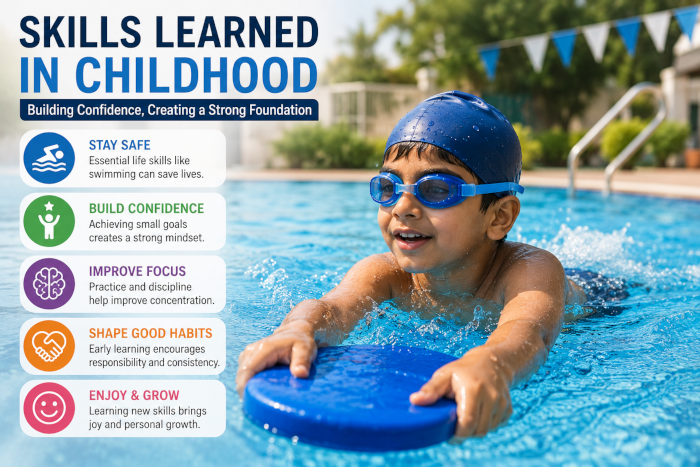
A skill I learned as a child was swimming. I was about seven years old, and my father used to take me to a public pool near our house every weekend during the summer. At first I was genuinely scared of the water, and I remember refusing to let go of the edge of the pool for weeks.
My father was patient though, and he would hold me under the arms while I kicked, letting go for a second or two longer each time. I practiced almost every weekend for about a year before I could swim a full length without stopping.
I think it is an important skill because it is not just a hobby, it can genuinely keep you safe around water. It also gave me real confidence as a child, since it was the first physical skill I actually worked hard for.
Useful Vocabulary for This Cue Card
These phrases describe learning and teaching naturally. None of them raises your score by itself, but using them accurately helps your answer sound more fluent.
Pick up a skill: to learn something gradually and informally. “I picked up most of my cooking just by watching my mother.”
Develop a skill: to improve at something over time. “I developed this mostly through practice, not lessons.”
Hands-on experience: practical, direct experience rather than theory. “I learned photography through hands-on experience.”
Learn through practice: to improve mainly by doing, not studying. “I learned guitar through practice rather than formal classes.”
Pass on my knowledge: to teach someone else what you know. “I would like to pass on my knowledge to a beginner.”
Teach someone step by step: to break a skill into manageable stages. “I would teach them step by step, not all at once.”
Build confidence: to gradually feel more capable at something. “Practicing regularly helped me build confidence with the camera.”
A practical skill: a skill with clear, everyday usefulness. “Cooking is a practical skill everyone can benefit from.”
Improve gradually: to get better slowly, over time. “My technique improved gradually over several months.”
Get the hang of something: to reach a basic level of competence. “It took a few tries, but she got the hang of it.”
Common Mistakes to Avoid
Choosing a Skill You Cannot Explain
Picking something that sounds impressive, like a rare skill you only tried once, often backfires because you run out of real detail after a sentence or two. A simple skill you know well is safer than an unusual one you cannot describe.
Giving Only General Information
Answers like “I am good at cooking and I would teach people how to cook” do not give the examiner much to work with. Add one specific detail to every part of your answer, not just the introduction.
Ignoring the Cue Card Points
Some candidates talk about a skill for two minutes without explaining how they learned it or how they would teach it. Glance at all four points while preparing, so you do not accidentally skip one.
Using Memorized Language
Reciting a prepared paragraph that does not quite match the actual question can sound unnatural. It is safer to memorize ideas and structure, not full sentences, and adjust the wording as you speak.
Speaking Too Briefly
Stopping after thirty or forty seconds is common, usually because the candidate ran out of prepared content. Adding one extra detail to each bullet point, such as a specific example, is usually enough to fill the full two minutes.
IELTS Speaking Part 3 Questions and Answers
1. What skills should children learn at school, besides academic subjects?
I think children should learn basic practical skills at school, like cooking simple meals or managing money, since these are things they will actually need as adults. Academic subjects matter too, but many everyday skills are never taught formally, so school could fill that gap.
2. Is it easier to learn skills from other people or from the internet?
It depends on the skill. Something physical, like swimming or an instrument, is usually easier to learn from a person who can correct you immediately. For more theoretical things, like basic coding, online resources work well because you can pause and revisit them.
3. Why do some people enjoy teaching others?
I think it is partly about feeling useful, and partly about understanding something even better by explaining it to someone else. Watching a person improve because of your help is also genuinely satisfying.
4. Should parents teach practical skills to their children at home?
I think so, at least the basics. Parents are usually the first people a child learns from, and things like cooking or budgeting are easier to pick up naturally at home than to learn from scratch later as an adult.
5. What skills do you think are especially important for young people today?
I would say digital skills are increasingly important because so much of daily life now happens online. Young people also need communication and problem-solving skills, especially when working with others or dealing with unfamiliar situations. I think the most useful approach is to develop both digital and practical skills rather than focusing on just one area.
6. Do people generally learn better by watching or by practicing?
For most physical skills, I think practice matters more, since watching only gets you so far before you actually need to try it yourself. Watching is still useful early on though, mainly to understand the basic idea before you start.
7. Should schools focus more on practical skills instead of theory?
I would not say instead of, but alongside it. Theory gives people a foundation, but many students leave school without ever learning fairly basic practical things, so a bit more balance would probably help most students.
8. Is it important for adults to keep learning new skills?
I think so, yes. Beyond just being useful, learning something new keeps your mind active, and it can be a good way to build confidence, especially with something you were nervous to try at first.
Frequently Asked Questions
What is a good skill to talk about in this IELTS cue card?
Choose something ordinary that you understand well enough to describe in detail, such as cooking or a basic craft. A skill you can explain step by step is more useful than one that just sounds impressive.
How long should I speak for in IELTS Speaking Part 2?
You get one minute to prepare and are expected to speak for one to two minutes. Aim closer to two minutes if you can, since a very short answer gives the examiner little to assess.
Can I talk about a skill I learned in childhood?
Yes, you can. If the cue card asks about a skill you learned in childhood, choose a skill you remember clearly and explain when you learned it, how you practised it, and why it became important to you. This is slightly different from the main cue card, which focuses on a skill you can teach other people.
Do I need to talk about a skill I am an expert in?
No. A skill you are reasonably comfortable with, and can actually explain, works better than one you barely know just because it sounds advanced.
How can I make my cue card answer sound natural?
Use your own real details instead of a memorized script. Add one small story, keep your linking words simple, and choose vocabulary you can use confidently while speaking.

