This IELTS Writing Task 2 question asks whether people should accept difficult circumstances or try to improve them. A strong response should discuss both views and make the writer’s position clear.
The Exact Question and What It’s Really Asking
Some people believe that it is best to accept a bad situation, such as an unsatisfactory job or shortage of money. Others argue that it is better to try and improve such situations.
Discuss both views and give your own opinion.
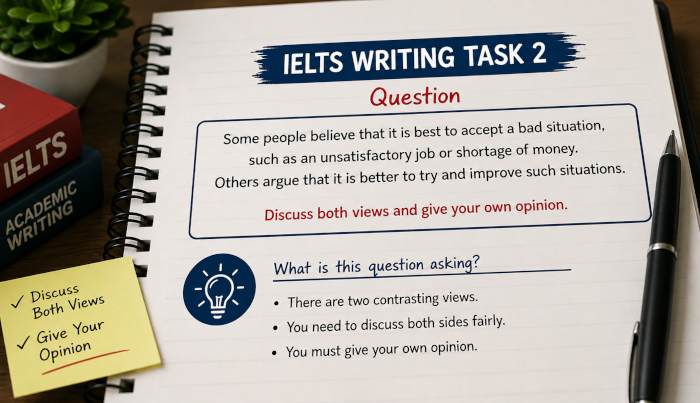
The first view is that when life hands you something difficult, whether that’s a job you don’t enjoy or not having enough money, the wisest response is to accept it rather than fight it.
The second view says the opposite: that unsatisfactory circumstances should be treated as problems to solve, not conditions to live with.
“Discuss both views” means explaining why someone might reasonably support each position, rather than discussing only the side you agree with.
“Give your own opinion” means making your position clear and supporting it throughout the essay.
What Type of Essay Is This?
This is a discussion essay, sometimes called a “discuss both views” essay. You need to explain both positions and give your own opinion. A clear two-sided structure can make the response easier to organize and develop.
Why a Clear, Consistent Opinion Matters
A weak response may discuss both sides but leave the writer’s position unclear until the final sentence. Your position should be clear and consistent throughout the essay rather than added as an afterthought.
There is no single “correct” opinion for this question. You can argue that acceptance is wiser, that trying to improve a situation is better, or that the best response depends on the circumstances. What matters is that your position is clear and consistent and that your arguments do not contradict each other.
Ideas for Both Views
Reasons to Accept a Bad Situation
- Some circumstances are outside a person’s control.
- Constant striving can increase stress without producing results.
- Not everyone has equal access to resources or opportunities.
Some circumstances are genuinely outside a person’s control. Not every bad situation can be fixed through effort or willpower. Economic downturns, chronic illness, or the loss of a loved one aren’t things a person can problem-solve their way out of. Spending energy fighting a situation like this, rather than adjusting to it, can lead to more suffering, not less. For example, someone diagnosed with a long-term health condition may find more stability in accepting the diagnosis and adapting their lifestyle than in repeatedly searching for a cure that doesn’t exist.
Constant striving can cause stress without producing results. There’s a real cost to always trying to change your circumstances, especially when success isn’t guaranteed. Someone who repeatedly applies for promotions they don’t get, or takes on side work that never quite pays off, can end up more anxious than if they had made peace with their situation and focused elsewhere. Acceptance, in this framing, is less about giving up and more about redirecting energy toward things that are actually within reach.
Not everyone has equal access to resources or opportunities. Improving a bad job or a low income often assumes the person has options: the ability to retrain, relocate, or take a financial risk. A single parent working an unsatisfying job may have very limited room to job-hunt or study for new qualifications. For that person, accepting the current situation while quietly managing it may be the most realistic choice, not a lack of ambition.
Reasons to Try and Improve a Bad Situation
- Passive acceptance can allow problems to become permanent.
- Taking action can build skills and resilience.
- Some situations are more changeable than they first appear.
Passive acceptance can allow a bad situation to become permanent. If nobody ever tried to fix an unsatisfactory job or a shortage of money, those problems would simply continue indefinitely. Even partial improvement, like negotiating better hours or taking on a small side income, changes the situation’s trajectory rather than freezing it in place. Someone who stays in a job they dislike for ten years without ever looking elsewhere is often worse off than someone who made several smaller, imperfect attempts to change course.
Taking action tends to build skills and resilience that acceptance doesn’t. A person who tries to retrain for a better career, even if the first attempt doesn’t fully succeed, comes out of it with new skills, contacts, or self-knowledge that someone who simply accepts a bad job rarely gains. This is one of the stronger arguments for the “improve” side: the process of trying often has value on its own, separate from whether the specific problem gets solved.
Many bad situations are more changeable than they first appear. A worker who feels stuck in a low-paying role may not have explored transferable skills or industries where their experience is valued more highly. Trying to improve the situation, even modestly, often reveals more flexibility than the person expected.
How to Structure Your Essay
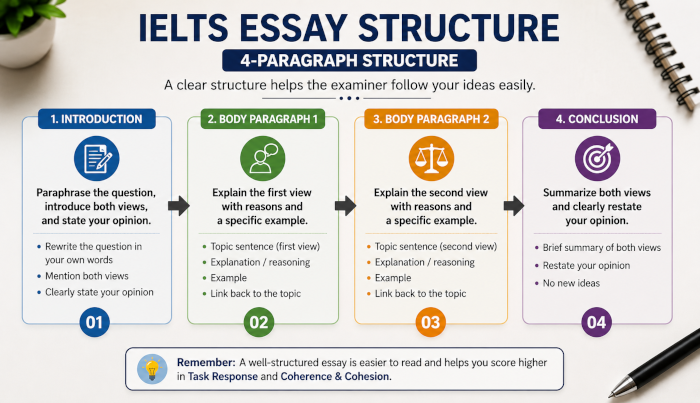
A clear four-paragraph structure can make this type of essay easier to plan and follow.
Introduction: Paraphrase the question, introduce both views, and state your opinion.
Body Paragraph 1: Explain the first view with reasoning and an example.
Body Paragraph 2: Explain the second view with reasoning and an example.
Conclusion: Summarize both views and clearly restate your opinion.
Introduction: Paraphrase, Outline and Opinion
Your introduction should paraphrase the question, briefly introduce both views, and state your opinion.
A short example:
People respond to difficult circumstances in different ways. Some believe that accepting an unsatisfactory job or financial hardship is more realistic, while others think people should take steps to improve their situation. Although acceptance may be sensible when circumstances cannot be changed, I believe that taking action is generally the better approach when improvement is possible.
Body Paragraph 1
Present the first view with a clear topic sentence, explanation, and specific example. Make sure the example directly supports the main idea and connects to the overall argument.
Body Paragraph 2
Develop the second view using the same basic pattern. If it reflects your opinion, you can give it slightly more development. Avoid simply contradicting the first paragraph; explain why the second perspective is convincing.
Conclusion
Summarize both views in a sentence or two, restate your opinion clearly, and stop there. A strong conclusion doesn’t introduce a new argument or a new example. Its purpose is to clearly restate your position and summarize the main argument.
Some People Believe That It Is Best to Accept a Bad Situation: Sample Essay
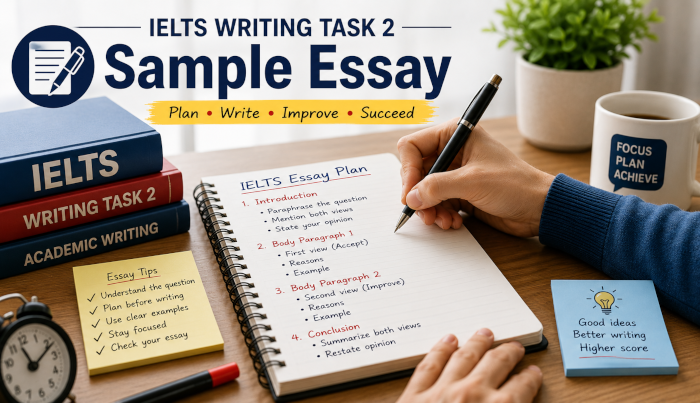
People often face circumstances they are unhappy with, whether that means a job that fails to satisfy them or an ongoing lack of money. Some believe the best response is simply to accept these situations as part of life. Others argue that people should make a genuine effort to improve them. In my view, while acceptance has its place, actively trying to change a difficult situation usually leads to a better outcome.
Those who favor acceptance often point out that constantly struggling against circumstances can cause unnecessary stress. Not every problem has a clear solution, and repeatedly trying to fix something that cannot easily be changed may only lead to frustration. For instance, a person coping with a permanent injury that limits their job options may find more peace by adjusting their expectations than by endlessly searching for a career that no longer suits their circumstances. In cases like this, acceptance can be a reasonable and even healthy response.
However, in most everyday situations, such as an unfulfilling job or limited income, taking action tends to produce more meaningful results than simply enduring the problem. Someone who dislikes their current role can pursue additional training, apply for other positions, or gradually build skills that open up better opportunities. Even if the first attempt does not fully succeed, the process itself can build confidence and practical experience. For example, someone working in an unfulfilling job might spend two years studying part time before moving into a more rewarding career. Had they simply accepted their situation, that change might never have happened.
In conclusion, although accepting certain unavoidable hardships can protect a person’s wellbeing, many difficult situations, particularly those involving work or money, can be improved through deliberate effort. For this reason, I believe that trying to change an unsatisfactory situation is generally the wiser and more constructive approach.
Paragraph-by-Paragraph Breakdown
Introduction: Paraphrases the question, introduces both positions, and gives a clear opinion.
Body Paragraph 1: Gives the acceptance view a fair explanation and supports it with a specific example. The paragraph also avoids repeatedly using the phrase “bad situation.”
Body Paragraph 2: Develops the view supported by the writer and uses a specific example to illustrate the argument. It also connects with the previous paragraph rather than ignoring the opposing position.
Conclusion: Acknowledges the value of acceptance in some situations before restating the writer’s position. It does not introduce a new argument.
A Model Paragraph for the Opposite View
If you’d rather argue that acceptance is the better approach, here’s how a body paragraph supporting that view might look:
Those who argue for acceptance often make a practical point: not every unsatisfactory situation can realistically be changed, and pretending otherwise can do more harm than good. A person working in a declining industry, for example, may find that retraining is expensive, time consuming, and far from guaranteed to succeed, especially later in their career. In such cases, accepting the situation and focusing energy on other sources of satisfaction, such as family or personal interests, can lead to a more stable and contented life than years spent chasing a change that may never come. Acceptance, in this sense, is not about giving up but about being realistic with limited time and resources.
Common Mistakes to Avoid on This Topic
Discussing only one view. Since this is a discussion essay, ignoring one side entirely means the response does not fully address the task and can negatively affect Task Response.
Giving an unclear or missing opinion. Some essays present both views fairly but never say which one the writer actually agrees with. The prompt asks for your opinion, so it needs to be unmistakable.
Treating it like an advantages and disadvantages essay. This question asks you to discuss views and give an opinion, not list pros and cons. Keep the focus on why people hold these beliefs, not a neutral breakdown of benefits.
Giving examples without explaining them. An example like “for instance, a person with a bad job,” left undeveloped, doesn’t do much work. Explain what happens in the example and why it supports your point.
Repeating the same idea in different words, or going off topic. If both body paragraphs make essentially the same point about stress or hard work, the essay feels thin even if it’s grammatically strong. Long detours into unrelated issues, like general career advice, dilute the focus too. Stay tied to accepting versus improving.
Using a memorized introduction. A generic introduction may not fit the specific question. A natural paraphrase of the actual question is more useful.
Misusing advanced vocabulary. A complicated word used incorrectly can make your writing less precise. Choose words you can use accurately.
Introducing a new idea in the conclusion. Your conclusion should summarize your position rather than introduce a new argument.
If you are preparing for IELTS Speaking as well, see our guide to “Do You Have a Pet?” sample answers for natural ways to answer this common Part 1 question.
Useful Vocabulary and Linking Phrases
| Term / Phrase | Meaning | Example |
|---|---|---|
| Unsatisfactory | Not good enough; disappointing | He described his job as unsatisfactory but stable. |
| Shortage | A lack of something needed | A shortage of money forced them to cut back on spending. |
| Come to terms with | To accept something difficult | She eventually came to terms with the delayed promotion. |
| Beyond one's control | Something a person cannot influence or change | A recession is largely beyond an individual's control. |
| Take action | To do something in response to a problem | Rather than complain, he decided to take action. |
| Make the best of it | To find a positive way to deal with a bad situation | They made the best of a difficult financial year. |
| Retrain | To learn new skills for a different job | She retrained as a nurse after losing her old job. |
| Resilience | The ability to recover from difficulty | Facing setbacks early built her resilience. |
| Complacency | Being too satisfied to make an effort to improve | Accepting every setback can lead to complacency. |
| Persevere | To continue trying despite difficulty | He persevered even after his first business failed. |
| Adapt to | To adjust to new or difficult circumstances | Employees had to adapt to the new working conditions. |
- “While some argue that… others believe…”
- “On the other hand…”
- “Others, however, argue that…”
Use these naturally, rather than dropping one in at the start of every paragraph out of habit.
Frequently Asked Questions
What type of IELTS essay is “Some people believe that it is best to accept a bad situation”?
A discussion essay, sometimes labeled “discuss both views.” You’re expected to explain both sides and then give your own opinion.
Do I have to fully agree with one side?
No. You can lean strongly toward one view, agree with parts of both, or argue it depends on the situation. What matters is that your position stays clear and consistent.
How many words should I write for IELTS Writing Task 2?
The task asks for a minimum of 250 words. Writing fewer than 250 words can negatively affect your score because the response may not fully develop the required ideas.
Do I really need to discuss both views, or can I just argue my opinion?
You need to discuss both. Arguing only one side, even convincingly, won’t fully answer the question.
Can I use examples that aren’t mentioned in the question?
Yes. The prompt mentions an unsatisfactory job and a shortage of money, but you can bring in other situations, such as health issues or circumstances outside a person’s control, as long as they support your argument.

